The group takes the elephant from the Countess's residence
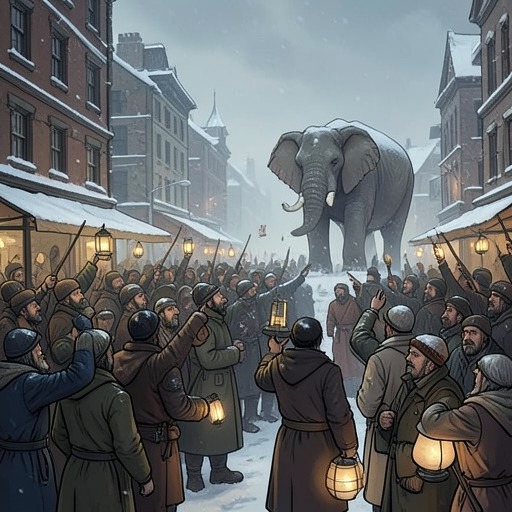
The Magician's ElephantThe group takes the elephant from the Countess's residence in a coordinated act that reverses her forced transfer into private ownership. The rescue begins with a knock at the enormous door built for her, but its meaning extends beyond the threshold: people previously divided by isolation, grief, and social position gather to bring the elephant out of confinement and accompany her through the snowy streets of Baltese.
From Accident to Possession
The elephant’s removal answers a crisis the law had no ready language for. The chief of police believes firmly in the letter of the law, yet repeated consultations of the police handbook produce no guidance for a beast that appeared from nowhere, destroyed an opera-house roof, and crippled a noblewoman. His bewilderment leads him to ask his subordinates what should be done. One suggests waiting to see whether the elephant disappears; another proposes that she be tried and punished as a criminal.
Leo Matienne challenges that proposed judgment by separating the damage from the elephant’s intention. He compares her to a rock thrown through a window: the rock causes the breakage, but it is not the responsible agent. The elephant did not ask to crash through the opera-house roof, Leo argues, and could not sensibly be guilty of an arrival she did not choose. The question of who may decide her fate remains unsettled, however. The police’s uncertainty does not protect her from custody; instead, it leaves room for power and ownership to determine what happens next.
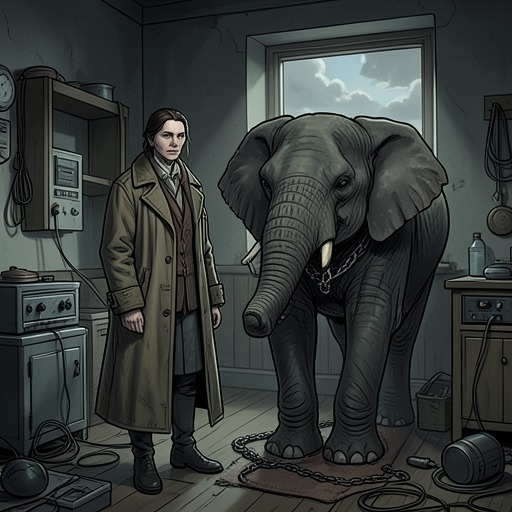
Countess Quintet secures possession by making a place for the elephant in her home. Since no existing doorway is large enough, she hires a dozen craftsmen, who work around the clock to knock down a wall and install an enormous, brightly painted and decorated door within a day. The elephant is brought there under cover of night, escorted by the chief of police. Once he leaves, the door is shut and locked behind her. The countess has also paid the opera-house owner enough to repair and retile the roof many times over, offered Bettine LaVaughn support in pursuing and punishing the magician, and contributed generously to the policemen’s fund. The elephant’s circumstances thus shift from unexplained accident to a carefully arranged confinement backed by money and official custody.
The Knock at the Elephant Door
The group’s approach begins with a decision about what must happen before anything else. Hans Ickman pushes Bettine LaVaughn’s wheelchair through the snowy streets, while Leo holds Peter Augustus Duchene’s hand. When LaVaughn questions the irregularity of their actions, Peter explains that the elephant must first be retrieved from the countess’s home and taken to the magician. LaVaughn protests the plan; Hans acknowledges that everyone may have gone a little mad. The exchange makes clear that this is not an authorized procedure but a course the group chooses despite the danger and apparent improbability.
At the residence, Peter, Leo, Hans, and LaVaughn stand together before the massive elephant door. Leo proposes beginning with a knock, and Hans agrees. They pound on the door and call out for someone to answer. The physical action is simple, but it reverses the terms of the elephant’s confinement: the group does not break through the wall or claim authority over the house. They ask to be admitted, directing their appeal toward the person who can open the barrier.
The door’s locks answer first. One deadbolt after another is thrown, and the door slowly opens. Bartok Whynn steps outside, looks up at the falling snow, and laughs. His reaction is not presented as a formal grant of permission, but the opening makes passage possible. In this encounter, a barrier built to accommodate the elephant becomes the threshold through which the rescuers can reach her.
Recognition and Release
Bartok fears what the countess will do if the elephant disappears while he is responsible for her. He imagines the countess waking to find the animal gone and holds himself accountable for allowing her to be spirited away; his laughter is so profound that it gives way to silence. Leo answers his fear by asking him to consider the possibility that he, too, might be gone the next morning, returned to the place where he was meant to be. Bartok looks at Leo, Hans, Peter, and LaVaughn as they wait together in the falling snow. In that stillness, he recognizes them as the figures from his dream.
The scene then shifts to the ballroom, where the elephant opens her eyes and sees Peter standing before her. She is not surprised; she understands that he has come for her. This recognition gives the rescue an intimate counterpart to the group’s public, coordinated effort. The elephant is not simply the object of a transfer from one owner or keeper to another: her response affirms the bond that has brought Peter to the door.
The Procession Through Baltese
The removal becomes visible as a procession through the city. Peter walks in front of the elephant carrying Adele; Leo walks beside him. Behind the elephant, LaVaughn rides in her wheelchair, pushed by Hans. Bartok follows Hans, Tomas follows Bartok, Iddo walks at Tomas’s heels, and Sister Marie brings up the rear. For the first time in fifty years, Sister Marie is not stationed at the door of the Orphanage of the Sisters of Perpetual Light. The group’s order gathers characters whose separate paths have converged around the elephant’s departure.
Adele remembers the elephant and asks where she is going. Peter answers that they are taking her home. As he leads the procession through the snow, lamp posts, doorways, trees, gates, and bricks seem to speak the words that had sustained his hope: she lives. The elephant’s warm breath on Peter’s cheek confirms the reality of what the journey has made possible. The movement away from the countess’s residence is therefore also movement toward a home the elephant has been longing for.
Consequences and Significance
The rescue reverses the countess’s claim that the elephant belongs to her completely, but the evidence does not describe a legal hearing or a negotiated change of ownership. What it shows instead is a collective decision enacted through presence, knocking, opening, and departure. The elephant leaves the ballroom with a group that includes people who had been isolated from one another, and the formerly imposing door becomes the point at which their separate intentions join in action.
The consequences reach beyond the elephant’s escape. After Bartok walks away into the swirling snow, LaVaughn feels a great weight break free of her and hugs Adele. She says the child is cold and that they should go inside; Leo agrees. This brief aftermath links the group’s risky intervention to a release in LaVaughn herself and to an immediate act of care. The procession does not erase the danger or suffering that preceded it, but it changes the direction of the story: the elephant is no longer shut behind the countess’s locked door, and Peter’s hope that his sister lives is answered by the living warmth beside him.